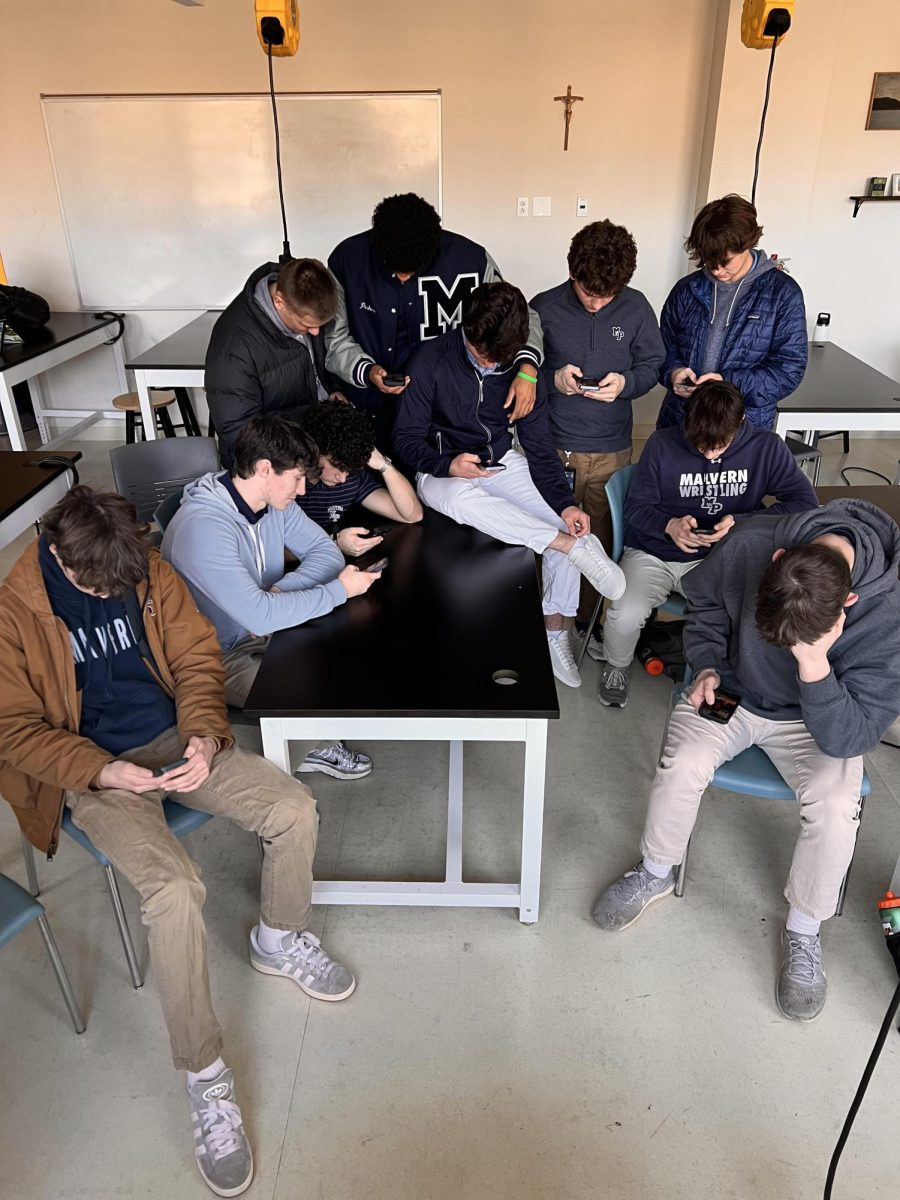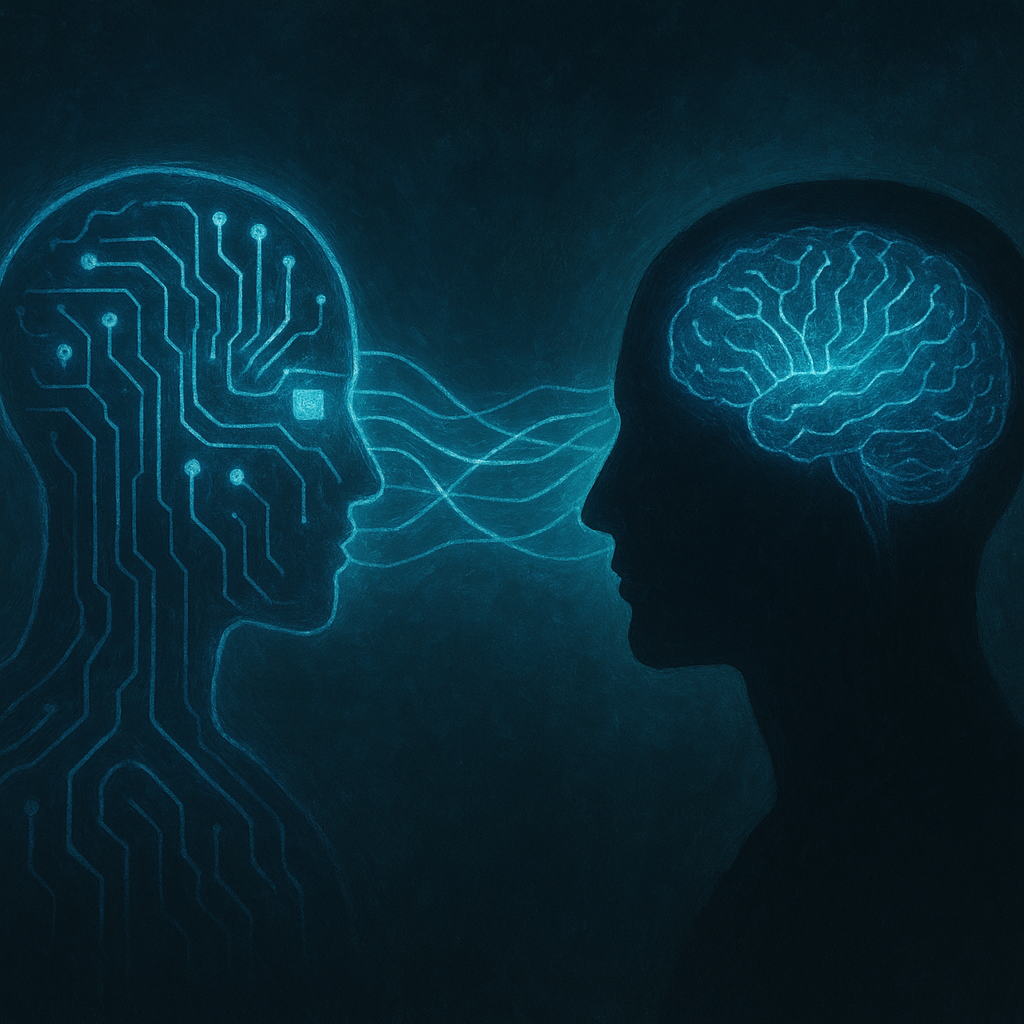

Schools are designed to educate students, but nowadays, education, along with much of our daily lives, is being reshaped by artificial intelligence. Frank Herbert, author of the Dune books series, wrote in 1965, “Once men turned their thinking over to machines in the hope that this would set them free. But that only permitted other men with machines to enslave them.” This remarkable and pervasive tool, software programs such as ChatGPT and Perplexity AI, are being used in classrooms, and their effects are so new, opening up new possibilities for individuals universally. Specifically, a majority of students use AI, which has sparked concern across many schools because they use it as a shortcut, diminishing their critical thinking and problem-solving capacity.
At Malvern Prep, teachers are well aware of the usage of Artificial Intelligence, and some classes are starting to work with the platform. Additionally, the main concern raised by teachers is about the relatively heavy reliance on these AI applications, which are diminishing students’ learning capabilities. This is somewhat of a concern for many kids since they are taking shortcuts instead of using their senses and intelligence.
Mr. Zak Hill, an Upper School Social Studies Teacher, shared his thoughts about how students rely on Artificial Intelligence. He emphasized the importance of being glued to the system and how students are choosing the wrong path.
“You guys just don’t think anymore. I have noticed in class just like asking a question, you guys just don’t make the same connections that you used to, because I don’t think you challenge yourself to do it as frequently as you used to. When human beings are given the ability to take the easy way out, we do it 100% of the time, but taking the easy way out in a lot of situations can have downstream impacts. It is about taking the easy way out. We’re not quite seeing it in full effect yet, but I think we’re getting close,” Mr. Hill said.
Mr. Hill also elaborated on how he is going to teach this year with AI becoming more utilized among students. Teaching in a classroom is extremely difficult with the implementation of artificial intelligence, so ensuring and aligning students are on the right track is challenging.
“To be perfectly honest, I’m kind of boycotting this year. I recognize that I can’t police it. I think as a general rule, people use it as a shortcut to skip around. We’ve had a few conversations in my class, and basically, I’m saying that for your schoolwork, I don’t think you should use it. There is not really any way to actually police it. That’s the tact I am taking this year. You got to learn how to crawl before you can walk. You have to learn how to walk before you run. You guys haven’t learned how to crawl yet, and for that reason and that reason alone, I just think it is developmentally not where you guys are,” Mr. Hill exclaimed.
In addition, Mr. Hill expressed his position on how schools should consider banning AI tools. Students are fully connected to the implementation, so enacting restrictions or policies could solve the issue. However, these thorough solutions addressing the problem might not actually solve the larger picture, as Mr. Hill said.
“Yeah we absolutely need to [ban AI]. This stuff is going to continue to improve and it really is either going to be the greatest invention in human history, or it is going to kill us all. But it’s just not possible. The way to [solve] it is to either make the invention not exist or to actually criminalize it. I don’t think you can do either . . . We have to find a way to convince people to not use it as a shortcut to completing a task because you can’t ban it,” Mr. Hill said.
A current Malvern prep senior, Donnie Sadoff, expressed the same views as Mr. Hill on how AI is used in negative and positive methods. Each individual needs to self-regulate based on their activity with AI, as Sadoff explains, because an excessive amount of reliance on the program can be detrimental. Therefore, people must be careful and monitor their usage.
“It’s a great tool, but it can really harm you. It’s something that is almost addictive. I think it’s human nature to try to do things as easy as possible, and AI enables that. So, it’s important that we establish our own integrity and discipline to do something that we’re proud of, and not just, you know, phone it in and use AI to fully supply our thoughts and ideas because what are we left with? I think a lot of people are using [AI] to try to make their day-to-day life easier. I mean, that’s the point of innovation and invention generally. But, I think generally people are just using it to try to lighten the load and not do anything too crazy,” Sadoff said.
Similarly, Mr. Jason Sammartino ‘04, Eleventh Grade Faculty Academy Leader and Upper School English Teacher, had equivalent perspectives with Donnie Sadoff about the usage of Artificial Intelligence. Mr. Sammartino has noticed a difference in students’ work and thinking, which is conspicuous in today’s learning environment. He touched on how students’ ethics are transforming in his class.
“I find it becoming a quick tool [or] a quick out instead of the brain work that is associated with writing or developing an idea. I believe strongly in this concept of time under tension, and the idea of hard work and hard thinking produces good results as long as it’s put forth in the right way. [AI] has taken those moments away, and when we lose those moments, my students seem to not want to put forth effort,” Sammartino explained.
He also elaborated on how schools should produce policies to halt artificial intelligence. It will progressively worsen over time, in which more and more students will become attached and use the system daily.
“Billion percent, yes. Should have been done years ago with Chat GPT-1. This should have been a thing. It’s becoming so rampant and everything is embracing some version of AI now. There’s no putting the toothpaste back in the tube here . . . so I think it’s just learning to work with it in stages,” said Mr. Sammartino.
Mr. Sammartino and Malvern’s Upper/Middle School Spanish Teacher, Mrs. Catherine Schroeder, also gave the same general ideas about the impact AI currently has on young students: the future of AI can hinder the learning environment for various subjects. This impact can become detrimental to education and ruin the younger generation.
“Currently, I think a lot of time, not in every case, but in some cases, when students have to do any side of any type of writing assignment for homework, that there is that temptation to use AI. Because of that, I try to do a lot of writing in class. I think AI can support learning; it obviously doesn’t replace all the benefits of learning language,” Mrs. Schroeder said.
She provided valuable insights on how AI policies should be implemented throughout schools and how to solve the rising issue, since the problem has been increasingly growing. She believes that schools should form policies to counter AI.
“Absolutely, yeah, I do. I think it also depends on the subject because AI can be more useful in certain subjects and more dangerous than others. I think that one of the most important things, in addition to establishing a policy, is to communicate the why to students. Students and people tend to understand policies and boundaries better when they understand the why. Teaching students how to use AI appropriately is one of the most important things to do,” Mrs. Schroeder said.
Conversely, learning a language can actually help students understand core concepts, as Schroeder states, by utilizing artificial intelligence. In this case, it widens the scope of retaining information as the system can develop useful words and clarify the translation reasoning.
“I think that AI can be used in the classroom to support learning in that it can provide a lot of comprehensible, relevant input. So when you learn a language, you need a lot of input, and AI is great at doing that. You can ask it to generate an authentic text with certain vocabulary. Personally, I use it for exactly that, if I like to bring authentic sources into the classroom, but if I really want to hone in on specific vocabulary, I can use AI to help generate texts,” Mrs. Schroeder said.
In accordance with Mrs. Schroeder’s stance, Mrs. Diane Giordano, Mathematics Curriculum Coordinator and Upper School Mathematics Teacher, views AI as a helpful tool for students. Math can be enigmatic and perplexing for students, but with AI, it guides students and walks them through problems; however, the answers it provides can be incorrect.
“I think it can be a positive tool in the math classroom. There’s always been Photo Math [an app that uses the phone’s camera to solve math problems], and calculators [which] have been used. So, it can help students check their work to see, but it can also be a negative tool because you know that the artificial intelligence can hallucinate [and] give flawed answers.”
Mrs. Giordano remarked about how it begins with the teachers: they are the ones who must teach the students about the capabilities that AI provides. Instead of using the innovation to obtain answers, students should learn to use it as a resource for extra assistance. From there, students can fully grasp and comprehend the material in their classes, which is pivotal in education.
“I think teachers have to really help the students understand how to use it correctly, and teachers have to be educated on it too. We have to be educated so that we can help guide the students. [AI] can hurt the students if they are not learning fundamental skills and just going home and using AI to get all their homework done; that can hurt them, but I think it can also help them to dive deeper into problems. This is a whole new world for us,” Giordano stated.
Indeed, the world, specifically education, is evolving. Many schools are facing the AI question and students’ rapid adoption of this technology in real time. Mr. Jeremy Bergman, a Middle School Social Studies Teacher at Great Valley Middle School, shared his view about the usage of artificial intelligence among his students. Bergman holds similar views to Malvern’s teachers regarding students working with artificial intelligence. He emphasized how kids use these systems routinely for school work.
“For me, with seventh graders and teaching social studies, I see a lot of [AI]. I see it as a shortcut. Oftentimes, I find kids using [AI] to get to the answer, but a lot of times the answer is devoid of context. I see a lot of kids jump into the fact versus the process. I know it’s a little bit more of a problem in the high school. The generative AI to write for you.” Mr. Bergman said.
Despite teaching in Middle, Mr. Bergman’s students had similar intentions and actions towards Malvern’s students, taking the shortcut. Taking the easy way out in situations will always be performed, no matter the cost. Simply, students taking shortcuts is a risk because they are not using reason and they are not learning school material. Mr. Bergman also commented on how schools should consider establishing AI policies.
“Absolutely, not just to pick on AI, but with any new technology, any new program, there should be a review period. There are plenty of studies out there right now saying AI is having negative effects on kids because it’s not teaching critical thinking skills. The problem is, with technology, it moves way faster than schools, teachers, administrators, and communities [meaning you] can’t really even build policies. We need to figure out what is acceptable,” Bergman said.
Currently, the ongoing concern of artificial intelligence needs to be addressed throughout schools. Teachers heavily support the idea of implementing methods to counter adverse AI usage, including Bergman. The entire system will strengthen over time, so creating policies now will benefit students. Furthermore, Mr. Bergman offered his critique of how AI will shape the future of learning.
“I’m a big science fiction guy so for me it’s kind of bleak because I’m seeing some signs out there. I feel strongly that learning occurs person-to-person. That can be done through computer [or] in a classroom. However, there’s a great TED-Ed about using avatars for AI to teach kids and that really does remove the human element. Nationwide, not enough of people are going into teaching for a variety of reasons. And some of the online tools that are out there [like Chegg], they’re firing half of their work staff who do online tutoring because kids would rather Chat GPT or Google AI tell them what to do, so bleak is my outlook,” Bergman said.
Students have developed a robust connection with the program, as it serves as a primary resource. Actually, Malvern Prep student Andrew Bian, Class of 2028, corroborated how his connection with AI is highly beneficial. AI serves as a big learning support system for him, and it helps clarify difficult concepts.
“I think of AI as a tool that aids me, that assists me in learning, instead of a tool that does the work for me. A lot of times, if I know how to do the homework, I just won’t use it at all. But if I’m stuck [or] if it is challenging, I’ll use Chat GPT to give me ideas on how to do the work, and I’ll take those ideas and transform them into original work that I did myself,” Bian stated.
Even though AI can be portrayed as a learning support system, there are still problems associated with its functionality. With these problems in mind, Bian discussed what the future holds for AI. He articulated that AI can be positive and negative in the classroom.
“I think it goes both ways. It depends on what the schools actually do in terms of regulating AI, if they do nothing about it, things are going to go down south, but if they’re smart enough about it, and they limit the use of AI, or maybe they use AI as a way of guided learning, they can definitely make a positive impact. If you overuse AI, it kind of hinders your creative ability. For me personally, back in the days when I wasn’t at Malvern, I would use AI a lot, and one time I chose not to use AI, and I felt I was way less productive in my work,” said Bian.
The impacts of these machines could have a monumental effect on the future of the education system, with a majority of the effects being negative, but there are some positives. At Malvern Prep, teachers have seen drastic effects that ultimately disconnect students from work ethic, and very well could have negative consequences down the road. As author George Herbert mentions, machines are not helping all people; machines run or controlled by a precious few are deteriorating the population. Critical thinking is being hijacked as AI lures people into using the system. Along those lines, the widespread adoption of artificial intelligence is a growing concern, potentially harming the future of students.